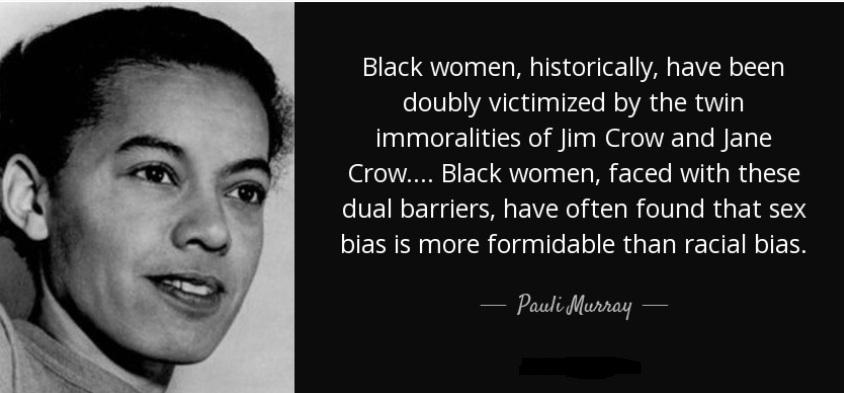
Today, for Black History Month, we remember Pauli Murray (November 20, 1910 – July 1, 1985), multiracial Black, LGBTQ Civil Rights and Gender Rights activist, labor organizer, poet, and Episcopal priest. S/he (to use the pronoun that s/he used for themself) was the first Black person to earn a Doctor of the Science of Law degree from Yale Law School, a founder of the National Organization for Women and the first Black person perceived as a woman to be ordained an Episcopal priest. Throughout the 1930s, Murray actively questioned their gender and sex, repeatedly asking doctors for hormone therapy and exploratory surgery to investigate their reproductive organs, but was denied gender-affirming medical care. When young, s/he changed their birth name from Pauline to the more masculine-sounding Pauli. And after earning a doctorate, s/he preferred people to refer to them as “doctor” rather than “miss.”
In March 1940, Murray was arrested and imprisoned for refusing to sit at the back of a bus in Virginia, more than fifteen years before Rosa Parks’s famous act of Civil Disobedience. That same year, Murray became the executive secretary for National Sharecroppers Week, whose goal was to raise awareness of the poor conditions of sharecroppers and raise money for the union’s organizing efforts. Not long after this, s/he cofounded the Congress of Racial Equality along with Bayard Rustin and others. S/he also attended Howard University in the early 1940s, where s/he coined the term “Jane Crow” to refer to the double oppression faced by black women. 1943, Murray led a lunch-counter sit-in, seventeen years before the sit-in movement began in Greensboro, North Carolina. In the early 1960s, Murray collaborated with A. Philip Randolph, Bayard Rustin, and Martin Luther King, but was critical of the sexism of the movement’s leadership. In 1966, they cofounded the National Organization for Women (NOW) with Betty Friedan, but later distanced themself from the organization because it did not seriously address the needs of working-class women of color.
After graduating from Howard, Murray tried to get into Harvard Law School, but was denied due to sexism. But Murray was accepted to the University of California Boalt School of Law, where s/he received Master of Law degree. Later earning another law degree from Yale. In 1951, they published the book States’ Laws on Race and Color, which Thurgood Marshall called the “bible” for Civil Rights litigators. In 1971, Ruth Bader Ginsburg named Murray as a coauthor of the ACLU brief in the landmark Supreme Court sex discrimination case Reed v. Reed, in recognition of her pioneering work on gender discrimination. Murray held faculty or administrative positions at the Ghana School of Law, Benedict College, and Brandeis University.
Murray wrote one of their greatest poems in 1943. It was a response to President Franklin Delano Roosevelt’s callous reaction to the Detroit Race Riot when he said that uprisings “endanger our national unity and comfort our enemies.” The poem’s title, “Mr. Roosevelt’s Regrets,” riffs on the Cole Porter song “Miss Otis Regrets.”
What’d you get, black boy
When they knocked you down in the gutter
And they kicked your teeth out
And they broke your skull with clubs
And they bashed your stomach in?
What’d you get when the police shot you in the back
And they chained you to the beds
While they wiped the blood off?
What’d you get when you cried out to the Top Man?
When you called on the man next to God, so you thought
And you asked him to speak out to save you?
What’d the Top Man say, black boy?
“Mr. Roosevelt regrets . . .”
#workingclass #LaborHistory #pualimurray #racism #sexism #feminism #lgbtq #transgender #gender #civilrights #civildisobedience #poetry #books #blackhistorymonth #BlackMastodon @bookstadon