
Discussion
Loading...

#Tag

Log in
  • Sign up
  • About
  • Code of conduct
  • Privacy
  • Users
  • Instances
  • About Bonfire
Inspirational Skeletor💀
@skeletor@mas.to  ·  activity timestamp 17 hours ago
Don't forget - you also have to do the inner work, not just look at memes.
Low Income Rent Homes
@homerent@mast.lat replied  ·  activity timestamp 10 hours ago

@skeletor
Stop Overpaying for Health Insurance!
Why drain your wallet on expensive coverage when affordable private health insurance is available right in your area? Compare top providers, get personalized quotes, and choose a plan that fits your budget — all in minutes.
✔ Compare trusted insurers
✔ Get custom quotes fast
✔ Plans tailored to your needs
✔ Enroll online or speak to an expert
✅Check details https://www.chd93jds.com/CD2KW8S/4G6SHH/
Your health matters — but overpaying doesn’t. Enter your ZIP code, explore your options, and secure the coverage your family deserves today.
#Health #LifeInsurance #insurance #plan


Sorry, no caption provided by author
https://www.chd93jds.com/CD2KW8S/4G6SHH/
  • Copy link
  • Flag this comment
  • Block
Signal
Signal
@signalapp@mastodon.world  ·  activity timestamp 2 weeks ago

RE: https://mastodon.world/@signalapp/113465595336718164

Signal video and voice calls are now supported for up to 75 participants!

Share your screen, raise your hand, react with the right emoji, and create easily shareable call links with Signal calls.

https://signal.org/blog/call-links/

Signal Messenger

Improving Private Signal Calls: Call Links & More

If you love group calls on Signal, but don’t want to create a group chat for every combination of your friends or colleagues, you’re in luck. Today we’re launching call links: Share a link with anyone on Signal and in just a tap or click they can join the call. No group chat required.
Low Income Rent Homes
@homerent@mast.lat replied  ·  activity timestamp 10 hours ago

@signalapp
Stop Overpaying for Health Insurance!
Why drain your wallet on expensive coverage when affordable private health insurance is available right in your area? Compare top providers, get personalized quotes, and choose a plan that fits your budget — all in minutes.
✔ Compare trusted insurers
✔ Get custom quotes fast
✔ Plans tailored to your needs
✔ Enroll online or speak to an expert
✅Check details https://www.chd93jds.com/CD2KW8S/4G6SHH/
Your health matters — but overpaying doesn’t. Enter your ZIP code, explore your options, and secure the coverage your family deserves today.
#Health #insurance

Sorry, no caption provided by author
https://www.chd93jds.com/CD2KW8S/4G6SHH/
  • Copy link
  • Flag this comment
  • Block
GhostOnTheHalfShell boosted
Daniel MacPhee 🔬🧬🧫🇨🇦
@dmacphee@mas.to  ·  activity timestamp 17 hours ago

“Nostalgia isn’t evidence”
This is so 🎯
#Science #Health #FactsMatter
https://www.mcgill.ca/oss/article/health-and-nutrition-pseudoscience-history/americas-healthier-past-no-more-myth

Office for Science and Society

America's Healthier Past is no More Than a Myth

This article was first published in The Montreal Gazette. “Make America healthy again” sounds like a great slogan. It is loaded with nostalgia and … haziness. What is that “again” all about? When were those halcyon days when Americans were healthier than now? Was it in 1900, when life expectancy was around 47 and one in five children did not reach adulthood, dying regularly from tuberculosis, diphtheria, measles, scarlet fever, whooping cough and diarrheal diseases from contaminated water, milk and food? Those who survived to adulthood then died from tuberculosis, pneumonia, typhoid fever and various other infectious diseases. Polio crippled many and childbirth was often deadly. Yeah … those healthy days. By 1950, life expectancy had climbed to 68 years thanks to water chlorination, milk pasteurization, better hygiene, antibiotic treatment of infections, vaccinations and a safer food supply thanks to preservatives and refrigeration. People were living long enough to develop heart disease due to smoking, less physical activity, unhealthy diets and undiagnosed hypertension. Today, U.S. life expectancy is around 78-79, thanks mostly to the reduction of infectious diseases that killed people early. Infections from a wound are no longer a death sentence, there is no worry about cholera being transmitted in drinking water, botulism from food is rare, toxic molds in grains can be controlled and effective medications for high blood pressure, elevated cholesterol, diabetes and some cancers are available. Obviously, there was no era in which Americans were healthier than now, except in a romanticized imagination. Is there really a desire to return to a time when snake-oil salesmen peddled their “cures,” syphilis was treated with mercury compounds, radium was thought to be a cure for arthritis, the mentally ill were locked up in asylums, polio victims spent their lives in iron lungs and tuberculosis patients were committed to sanatoriums? Instead of looking back to a mythical “healthier” past, we need to look to the future to try to deal with the conditions that have emerged as a result of increased longevity. These include an epidemic of obesity, a rise in Type 2 diabetes, an increase in cancers in young adults and the emergence of “metabolic syndrome,” a cluster of conditions — high blood pressure, high blood sugar, excess abdominal fat and high cholesterol — that increases the risk of heart disease, stroke and diabetes. A more realistic slogan than MAHA would be “Make America healthier.” And there is plenty of room to do that. Among developed countries, the U.S. ranks around 30th in life expectancy (Canada’s life expectancy exceeds this by three to four years), its infant mortality rate is one of the worst among wealthy countries, and the U.S. has one of the highest rates of obesity, Type 2 diabetes and hypertension, all of which can be addressed with lifestyle modifications. On the other hand, the U.S. ranks very high in medical care. Screening for breast, prostate and colorectal cancer is effective and treatment after diagnosis is first-rate. In other words, the U.S. is very bad at preventing people from getting sick but is very good at treating them after they get sick. Robert F. Kennedy Jr., who bizarrely occupies the position of U.S. Secretary of Health and Human Services despite having no relevant science background, seemingly wants to remedy the situation. Curiously, in pursuit of better health he has mounted a crusade against current vaccination recommendations. I say “curiously,” because vaccination has been one of the greatest scientific triumphs in history, with smallpox being totally eliminated, global cases of polio reduced by 99 per cent, and diphtheria, tetanus, rubella, whooping cough and mumps being converted into rare diseases. Measles, a potentially deadly disease, was on the verge of being wiped out until Andrew Wakefield published his scientifically dreadful paper linking the mumps, measles and rubella vaccine to autism. Vaccines against shingles, meningitis, pneumonia, human papilloma virus and rotavirus are also effective. According to the World Health Organization, tens of millions of deaths have been prevented by vaccines in the 20th century. Kennedy’s pseudoscientific attempts to change vaccination schedules that have been proved to prevent illness borders on the criminal. Americans will pay not only with their health but with their wallets; treatment of preventable diseases costs a fortune. Kennedy is on somewhat firmer ground when it comes to an effort to make Americans healthier with the recently released Dietary Guidelines for Americans. The introduction reads, “Under President (Donald) Trump’s leadership, we are restoring scientific integrity and accountability to federal food and health policy.” It should be noted that Trump drinks multiple Diet Cokes a day, disdains vegetables and dines regularly on burgers, pizza, fried chicken and well-done steak. However, let’s give credit where it is due: In line with accepted science, the guidelines do emphasize paying attention to portion size and they do steer people away from highly processed foods, something that seems to have escaped the president’s attention. There is emphasis on avoiding added sugar and curbing refined carbohydrates. Recommendations to eat more fibre and fermented foods that support microbial diversity in the gut are evidence-based. So is advice to cut down on alcohol, although “consume less alcohol for better overall health” is meaningless without introducing amounts. Now for the downsides. Mercifully, there is no recommendation to drink raw milk that Kennedy wrongly believes has nutritional benefits. The advice to increase protein intake to 1.2-16 grams per kg of body weight is not backed by evidence and neither is the need to have three servings of dairy a day. Some independent reviews have suggested that several members of the guidelines committee have ties to the beef and dairy industry. Kennedy’s misguided pledge “to end the war on saturated fats” has resulted in placing red meat and high-fat dairy at the top of the inverted pyramid published along with the guidelines, with fruit and whole grains relegated to the bottom. The recommendation to limit calories from saturated fat to 10 per cent of total calories has been maintained, but this does not mesh with the suggestion to eat more meat and cook with beef tallow and butter. The latter is said to contain essential fatty acids, which it does not. While there is some evidence that saturated fats in dairy may not have the same impact on heart disease as saturated fats in other foods, touting meat as containing “healthy fats” has no basis. The guidelines also fail to point out that processed meats specifically have been linked with poor health outcomes. While the new guidelines are by not disastrous, they are not quite in step with the long-tanding recommendation to choose mono- and polyunsaturated fats over saturated fats, which basically translates to eating more plant-based foods. Still, if the advice to cut down on highly processed foods and refined carbohydrates is followed, Americans can be on the way to being healthier. As far as those supposedly healthier bygone eras, people may have been thinner, but they definitely were not healthier. @‌JoeSchwarcz
  • Copy link
  • Flag this post
  • Block
Daniel MacPhee 🔬🧬🧫🇨🇦
@dmacphee@mas.to  ·  activity timestamp 17 hours ago

“Nostalgia isn’t evidence”
This is so 🎯
#Science #Health #FactsMatter
https://www.mcgill.ca/oss/article/health-and-nutrition-pseudoscience-history/americas-healthier-past-no-more-myth

Office for Science and Society

America's Healthier Past is no More Than a Myth

This article was first published in The Montreal Gazette. “Make America healthy again” sounds like a great slogan. It is loaded with nostalgia and … haziness. What is that “again” all about? When were those halcyon days when Americans were healthier than now? Was it in 1900, when life expectancy was around 47 and one in five children did not reach adulthood, dying regularly from tuberculosis, diphtheria, measles, scarlet fever, whooping cough and diarrheal diseases from contaminated water, milk and food? Those who survived to adulthood then died from tuberculosis, pneumonia, typhoid fever and various other infectious diseases. Polio crippled many and childbirth was often deadly. Yeah … those healthy days. By 1950, life expectancy had climbed to 68 years thanks to water chlorination, milk pasteurization, better hygiene, antibiotic treatment of infections, vaccinations and a safer food supply thanks to preservatives and refrigeration. People were living long enough to develop heart disease due to smoking, less physical activity, unhealthy diets and undiagnosed hypertension. Today, U.S. life expectancy is around 78-79, thanks mostly to the reduction of infectious diseases that killed people early. Infections from a wound are no longer a death sentence, there is no worry about cholera being transmitted in drinking water, botulism from food is rare, toxic molds in grains can be controlled and effective medications for high blood pressure, elevated cholesterol, diabetes and some cancers are available. Obviously, there was no era in which Americans were healthier than now, except in a romanticized imagination. Is there really a desire to return to a time when snake-oil salesmen peddled their “cures,” syphilis was treated with mercury compounds, radium was thought to be a cure for arthritis, the mentally ill were locked up in asylums, polio victims spent their lives in iron lungs and tuberculosis patients were committed to sanatoriums? Instead of looking back to a mythical “healthier” past, we need to look to the future to try to deal with the conditions that have emerged as a result of increased longevity. These include an epidemic of obesity, a rise in Type 2 diabetes, an increase in cancers in young adults and the emergence of “metabolic syndrome,” a cluster of conditions — high blood pressure, high blood sugar, excess abdominal fat and high cholesterol — that increases the risk of heart disease, stroke and diabetes. A more realistic slogan than MAHA would be “Make America healthier.” And there is plenty of room to do that. Among developed countries, the U.S. ranks around 30th in life expectancy (Canada’s life expectancy exceeds this by three to four years), its infant mortality rate is one of the worst among wealthy countries, and the U.S. has one of the highest rates of obesity, Type 2 diabetes and hypertension, all of which can be addressed with lifestyle modifications. On the other hand, the U.S. ranks very high in medical care. Screening for breast, prostate and colorectal cancer is effective and treatment after diagnosis is first-rate. In other words, the U.S. is very bad at preventing people from getting sick but is very good at treating them after they get sick. Robert F. Kennedy Jr., who bizarrely occupies the position of U.S. Secretary of Health and Human Services despite having no relevant science background, seemingly wants to remedy the situation. Curiously, in pursuit of better health he has mounted a crusade against current vaccination recommendations. I say “curiously,” because vaccination has been one of the greatest scientific triumphs in history, with smallpox being totally eliminated, global cases of polio reduced by 99 per cent, and diphtheria, tetanus, rubella, whooping cough and mumps being converted into rare diseases. Measles, a potentially deadly disease, was on the verge of being wiped out until Andrew Wakefield published his scientifically dreadful paper linking the mumps, measles and rubella vaccine to autism. Vaccines against shingles, meningitis, pneumonia, human papilloma virus and rotavirus are also effective. According to the World Health Organization, tens of millions of deaths have been prevented by vaccines in the 20th century. Kennedy’s pseudoscientific attempts to change vaccination schedules that have been proved to prevent illness borders on the criminal. Americans will pay not only with their health but with their wallets; treatment of preventable diseases costs a fortune. Kennedy is on somewhat firmer ground when it comes to an effort to make Americans healthier with the recently released Dietary Guidelines for Americans. The introduction reads, “Under President (Donald) Trump’s leadership, we are restoring scientific integrity and accountability to federal food and health policy.” It should be noted that Trump drinks multiple Diet Cokes a day, disdains vegetables and dines regularly on burgers, pizza, fried chicken and well-done steak. However, let’s give credit where it is due: In line with accepted science, the guidelines do emphasize paying attention to portion size and they do steer people away from highly processed foods, something that seems to have escaped the president’s attention. There is emphasis on avoiding added sugar and curbing refined carbohydrates. Recommendations to eat more fibre and fermented foods that support microbial diversity in the gut are evidence-based. So is advice to cut down on alcohol, although “consume less alcohol for better overall health” is meaningless without introducing amounts. Now for the downsides. Mercifully, there is no recommendation to drink raw milk that Kennedy wrongly believes has nutritional benefits. The advice to increase protein intake to 1.2-16 grams per kg of body weight is not backed by evidence and neither is the need to have three servings of dairy a day. Some independent reviews have suggested that several members of the guidelines committee have ties to the beef and dairy industry. Kennedy’s misguided pledge “to end the war on saturated fats” has resulted in placing red meat and high-fat dairy at the top of the inverted pyramid published along with the guidelines, with fruit and whole grains relegated to the bottom. The recommendation to limit calories from saturated fat to 10 per cent of total calories has been maintained, but this does not mesh with the suggestion to eat more meat and cook with beef tallow and butter. The latter is said to contain essential fatty acids, which it does not. While there is some evidence that saturated fats in dairy may not have the same impact on heart disease as saturated fats in other foods, touting meat as containing “healthy fats” has no basis. The guidelines also fail to point out that processed meats specifically have been linked with poor health outcomes. While the new guidelines are by not disastrous, they are not quite in step with the long-tanding recommendation to choose mono- and polyunsaturated fats over saturated fats, which basically translates to eating more plant-based foods. Still, if the advice to cut down on highly processed foods and refined carbohydrates is followed, Americans can be on the way to being healthier. As far as those supposedly healthier bygone eras, people may have been thinner, but they definitely were not healthier. @‌JoeSchwarcz
  • Copy link
  • Flag this post
  • Block
GhostOnTheHalfShell boosted
PrivacyDigest
PrivacyDigest
@PrivacyDigest@mas.to  ·  activity timestamp yesterday

#MAHA moms threaten to turn this car around as #RFK Jr. flips on #pesticide

Members of the Make America Health Again movement are in open revolt after founder Robert F. Kennedy Jr. publicly backed President Trump's executive order Wednesday that would increase domestic production of #glyphosate —a pesticide the MAHA movement and #Kennedy have railed against.
#health #maga #Trump

https://arstechnica.com/health/2026/02/maha-moms-threaten-to-turn-this-car-around-as-rfk-jr-flips-on-pesticide/

Ars Technica

MAHA moms threaten to turn this car around as RFK Jr. flips on pesticide

MAHA members call movement a "sham" after Kennedy supports glyphosate order.
  • Copy link
  • Flag this post
  • Block
PrivacyDigest
PrivacyDigest
@PrivacyDigest@mas.to  ·  activity timestamp yesterday

#MAHA moms threaten to turn this car around as #RFK Jr. flips on #pesticide

Members of the Make America Health Again movement are in open revolt after founder Robert F. Kennedy Jr. publicly backed President Trump's executive order Wednesday that would increase domestic production of #glyphosate —a pesticide the MAHA movement and #Kennedy have railed against.
#health #maga #Trump

https://arstechnica.com/health/2026/02/maha-moms-threaten-to-turn-this-car-around-as-rfk-jr-flips-on-pesticide/

Ars Technica

MAHA moms threaten to turn this car around as RFK Jr. flips on pesticide

MAHA members call movement a "sham" after Kennedy supports glyphosate order.
  • Copy link
  • Flag this post
  • Block
Lord Caramac the Clueless, KSC and 1 other boosted

Natasha :mastodon: :verified:
@Natasha_Jay@tech.lgbt  ·  activity timestamp yesterday

NewScientist: "Antibodies harvested from the blood of paediatricians are up to 25 times better at protecting against the common respiratory infection RSV than existing antibody therapies, and are now being developed as preventative treatments"

This is both so logical and yet absurdly like a science fiction story ...

https://www.newscientist.com/article/2516079-paediatricians-blood-used-to-make-new-treatments-for-rsv-and-colds/

#Science #Health

New Scientist

Paediatricians’ blood used to make new treatments for RSV and colds

Antibodies harvested from the blood of paediatricians are up to 25 times better at protecting against the common respiratory infection RSV than existing antibody therapies, and are now being developed as preventative treatments
  • Copy link
  • Flag this post
  • Block
Natasha :mastodon: :verified:
@Natasha_Jay@tech.lgbt  ·  activity timestamp yesterday

NewScientist: "Antibodies harvested from the blood of paediatricians are up to 25 times better at protecting against the common respiratory infection RSV than existing antibody therapies, and are now being developed as preventative treatments"

This is both so logical and yet absurdly like a science fiction story ...

https://www.newscientist.com/article/2516079-paediatricians-blood-used-to-make-new-treatments-for-rsv-and-colds/

#Science #Health

New Scientist

Paediatricians’ blood used to make new treatments for RSV and colds

Antibodies harvested from the blood of paediatricians are up to 25 times better at protecting against the common respiratory infection RSV than existing antibody therapies, and are now being developed as preventative treatments
  • Copy link
  • Flag this post
  • Block
GhostOnTheHalfShell boosted
Nonilex
Nonilex
@Nonilex@masto.ai  ·  activity timestamp 3 days ago

Reinventing the wheel — badly

After leaving the #WHO, #Trump officials propose a replacement 3 times more expensive to duplicate it
#HHS proposes spending $2 billion a year to re-create systems the #US accessed through the #WorldHealthOrganization at a fraction of the #cost, according to officials briefed on the matter.

#idiocracy #kakistocracy #law #policy #GovernmentSpending #PublicHealth #health #USpol
https://www.washingtonpost.com/health/2026/02/19/alternative-world-health-organization-proposal/

  • Copy link
  • Flag this post
  • Block
Anna Cats 🐱
Anna Cats 🐱
@Annacats@mastodon.social  ·  activity timestamp 3 days ago

Topic of discussion❤️.
The Fear After a Vet Visit
Waiting for results feels like holding your breath.anxiety, uncertainty and helpless love.

Prompt:
Do vet visits make you more nervous than your cat?

#cats #health #catlovers #pets #CatsOfMastodon

A sweet ginger tabby cat curled up in a small shelf space, with soft striped fur, round curious eyes, and a calm, slightly shy expression.
  • Copy link
  • Flag this post
  • Block
GhostOnTheHalfShell boosted
Nonilex
Nonilex
@Nonilex@masto.ai  ·  activity timestamp 3 days ago

“ #Spending 2 to 3 times the #cost to create what we already had access to makes absolutely no sense in terms of fiscal stewardship,” said Tom Inglesby, director Center for Health Security at the Johns Hopkins Bloomberg School of #PublicHealth, who served as a snr covid19 adviser during the Biden admin. “We’re not going to get the same quality or breadth of information we would have by being in the #WHO, or have anywhere the influence we had.”

#Trump #idiocracy #kakistocracy #law #health #USpol

  • Copy link
  • Flag this post
  • Block
Nonilex
Nonilex
@Nonilex@masto.ai  ·  activity timestamp 3 days ago

While #Trump accused the #WHO of demanding “unfairly onerous payments,” the alternative his administration is considering carries a price tag about three times what the #US contributed annually to the #UN #health agency. The US would build on bilateral agreements with countries & expand the presence of its health agencies to dozens of additional nations [starting from scratch], the officials said.

#idiocracy #kakistocracy #law #policy #GovernmentSpending #PublicHealth #USpol

Nonilex
Nonilex
@Nonilex@masto.ai replied  ·  activity timestamp 3 days ago

“ #Spending 2 to 3 times the #cost to create what we already had access to makes absolutely no sense in terms of fiscal stewardship,” said Tom Inglesby, director Center for Health Security at the Johns Hopkins Bloomberg School of #PublicHealth, who served as a snr covid19 adviser during the Biden admin. “We’re not going to get the same quality or breadth of information we would have by being in the #WHO, or have anywhere the influence we had.”

#Trump #idiocracy #kakistocracy #law #health #USpol

  • Copy link
  • Flag this comment
  • Block
Nonilex
Nonilex
@Nonilex@masto.ai  ·  activity timestamp 3 days ago

The effort to build a #US run alternative would re-create systems such as laboratories, data-sharing networks & rapid-response systems the US abandoned when it announced its withdrawal from the #WHO last year & dismantled the US Agency for International Development [ #USAID], according to the officials, who spoke on the condition of anonymity to share internal deliberations.

#Trump #idiocracy #kakistocracy #law #policy #GovernmentSpending #PublicHealth #health #USpol

Nonilex
Nonilex
@Nonilex@masto.ai replied  ·  activity timestamp 3 days ago

While #Trump accused the #WHO of demanding “unfairly onerous payments,” the alternative his administration is considering carries a price tag about three times what the #US contributed annually to the #UN #health agency. The US would build on bilateral agreements with countries & expand the presence of its health agencies to dozens of additional nations [starting from scratch], the officials said.

#idiocracy #kakistocracy #law #policy #GovernmentSpending #PublicHealth #USpol

  • Copy link
  • Flag this comment
  • Block
Nonilex
Nonilex
@Nonilex@masto.ai  ·  activity timestamp 3 days ago

After pulling out of the #WorldHealthOrganization, the #Trump administration is proposing spending $2 billion a year to replicate the #global #disease surveillance & outbreak functions the #UnitedStates helped build & accessed at a fraction of the #cost, according to 3 administration officials briefed on the proposal.
#idiocracy #kakistocracy #law #policy #GovernmentSpending #PublicHealth #health #WHO #USpol

Nonilex
Nonilex
@Nonilex@masto.ai replied  ·  activity timestamp 3 days ago

The effort to build a #US run alternative would re-create systems such as laboratories, data-sharing networks & rapid-response systems the US abandoned when it announced its withdrawal from the #WHO last year & dismantled the US Agency for International Development [ #USAID], according to the officials, who spoke on the condition of anonymity to share internal deliberations.

#Trump #idiocracy #kakistocracy #law #policy #GovernmentSpending #PublicHealth #health #USpol

  • Copy link
  • Flag this comment
  • Block
Nonilex
Nonilex
@Nonilex@masto.ai  ·  activity timestamp 3 days ago

Reinventing the wheel — badly

After leaving the #WHO, #Trump officials propose a replacement 3 times more expensive to duplicate it
#HHS proposes spending $2 billion a year to re-create systems the #US accessed through the #WorldHealthOrganization at a fraction of the #cost, according to officials briefed on the matter.

#idiocracy #kakistocracy #law #policy #GovernmentSpending #PublicHealth #health #USpol
https://www.washingtonpost.com/health/2026/02/19/alternative-world-health-organization-proposal/

Nonilex
Nonilex
@Nonilex@masto.ai replied  ·  activity timestamp 3 days ago

After pulling out of the #WorldHealthOrganization, the #Trump administration is proposing spending $2 billion a year to replicate the #global #disease surveillance & outbreak functions the #UnitedStates helped build & accessed at a fraction of the #cost, according to 3 administration officials briefed on the proposal.
#idiocracy #kakistocracy #law #policy #GovernmentSpending #PublicHealth #health #WHO #USpol

  • Copy link
  • Flag this comment
  • Block
Nonilex
Nonilex
@Nonilex@masto.ai  ·  activity timestamp 3 days ago

Reinventing the wheel — badly

After leaving the #WHO, #Trump officials propose a replacement 3 times more expensive to duplicate it
#HHS proposes spending $2 billion a year to re-create systems the #US accessed through the #WorldHealthOrganization at a fraction of the #cost, according to officials briefed on the matter.

#idiocracy #kakistocracy #law #policy #GovernmentSpending #PublicHealth #health #USpol
https://www.washingtonpost.com/health/2026/02/19/alternative-world-health-organization-proposal/

  • Copy link
  • Flag this post
  • Block
GhostOnTheHalfShell boosted
Miss Gayle
Miss Gayle
@MissGayle@urbanists.social  ·  activity timestamp 4 days ago

Contrary to a certain worm-eaten brain's opinions, meat every day is not the way to health.

The Knights Templar, legendary warriors of yore, only ate meat a few days a week at dinner, 4 days maximum, not at every meal every day.

Their diet was largely vegetarian with eggs & cheese, and fish on Fridays - and they lived way longer than most people of that era.

So eat your oatmeal, class. Lay off the bacon.

Link: https://www.atlasobscura.com/articles/what-the-templar-knights-ate
#Diet #Meat #MediterraneanDiet #History #Food #Health

How a Special Diet Kept the Knights Templar Fighting Fit
Silent meals, a buddy system, and wine “in moderation.”
by Natasha Frost, May 8, 2018

In the 13th century, the average life expectancy was a mere 31 years, yet,
miraculously, many members of the fabled Knights Templar lived long past
60. Even then, they often died at the hands of their enemies, rather than
from illness. The knights’ good health seemed like a divine gift, but modern
research suggests an alternative: The order’s compulsory dietary rules may
have contributed to their long lives.

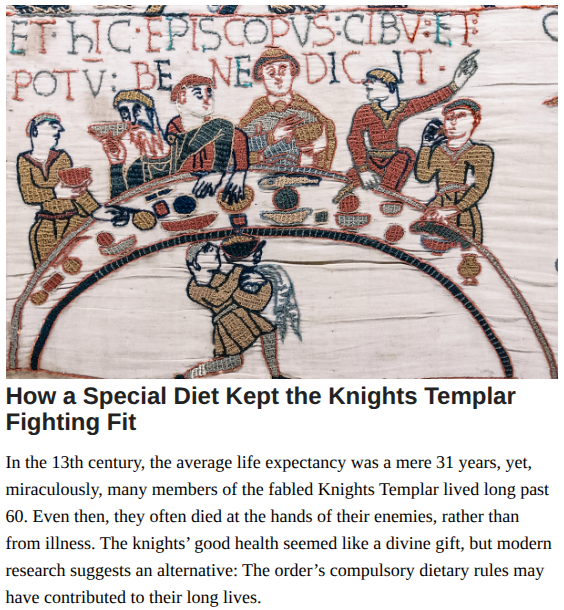
Teaser Image: Meals were eaten communally and may have looked rather like this feast scene from the Bayeux tapestry—albeit rather less raucous. Public Domain

"So three times a week, the knights were permitted to eat meat—even though it was “understood that the custom of eating flesh corrupts the body.” On Sundays, everyone ate meat, with higher-up members permitted both lunch and dinner with some kind of roast animal...but on Mondays, Wednesdays, and Saturdays, the knights ate more spartan, vegetable-filled meals....Otherwise, they might eat potage, made with oats or pulses, gruels, or fiber-rich vegetable stews. In their gardens, they grew fruits and vegetables, especially Mediterranean produce...

Once a week, on Fridays, they observed a Lenten fast—no eggs, milk, or other animal products. For hearty fare, they relied on dried or salted fish, and dairy or egg substitutes made from almond milk."
How a Special Diet Kept the Knights Templar Fighting Fit Silent meals, a buddy system, and wine “in moderation.” by Natasha Frost, May 8, 2018 In the 13th century, the average life expectancy was a mere 31 years, yet, miraculously, many members of the fabled Knights Templar lived long past 60. Even then, they often died at the hands of their enemies, rather than from illness. The knights’ good health seemed like a divine gift, but modern research suggests an alternative: The order’s compulsory dietary rules may have contributed to their long lives. Teaser Image: Meals were eaten communally and may have looked rather like this feast scene from the Bayeux tapestry—albeit rather less raucous. Public Domain "So three times a week, the knights were permitted to eat meat—even though it was “understood that the custom of eating flesh corrupts the body.” On Sundays, everyone ate meat, with higher-up members permitted both lunch and dinner with some kind of roast animal...but on Mondays, Wednesdays, and Saturdays, the knights ate more spartan, vegetable-filled meals....Otherwise, they might eat potage, made with oats or pulses, gruels, or fiber-rich vegetable stews. In their gardens, they grew fruits and vegetables, especially Mediterranean produce... Once a week, on Fridays, they observed a Lenten fast—no eggs, milk, or other animal products. For hearty fare, they relied on dried or salted fish, and dairy or egg substitutes made from almond milk."
  • Copy link
  • Flag this post
  • Block
Miss Gayle
Miss Gayle
@MissGayle@urbanists.social  ·  activity timestamp 4 days ago

Contrary to a certain worm-eaten brain's opinions, meat every day is not the way to health.

The Knights Templar, legendary warriors of yore, only ate meat a few days a week at dinner, 4 days maximum, not at every meal every day.

Their diet was largely vegetarian with eggs & cheese, and fish on Fridays - and they lived way longer than most people of that era.

So eat your oatmeal, class. Lay off the bacon.

Link: https://www.atlasobscura.com/articles/what-the-templar-knights-ate

#Diet #Meat #MediterraneanDiet #History #Food #Health

How a Special Diet Kept the Knights Templar Fighting Fit
Silent meals, a buddy system, and wine “in moderation.”
by Natasha Frost, May 8, 2018

In the 13th century, the average life expectancy was a mere 31 years, yet,
miraculously, many members of the fabled Knights Templar lived long past
60. Even then, they often died at the hands of their enemies, rather than
from illness. The knights’ good health seemed like a divine gift, but modern
research suggests an alternative: The order’s compulsory dietary rules may
have contributed to their long lives.

Teaser Image: Meals were eaten communally and may have looked rather like this feast scene from the Bayeux tapestry—albeit rather less raucous. Public Domain

"So three times a week, the knights were permitted to eat meat—even though it was “understood that the custom of eating flesh corrupts the body.” On Sundays, everyone ate meat, with higher-up members permitted both lunch and dinner with some kind of roast animal...but on Mondays, Wednesdays, and Saturdays, the knights ate more spartan, vegetable-filled meals....Otherwise, they might eat potage, made with oats or pulses, gruels, or fiber-rich vegetable stews. In their gardens, they grew fruits and vegetables, especially Mediterranean produce...

Once a week, on Fridays, they observed a Lenten fast—no eggs, milk, or other animal products. For hearty fare, they relied on dried or salted fish, and dairy or egg substitutes made from almond milk."
How a Special Diet Kept the Knights Templar Fighting Fit Silent meals, a buddy system, and wine “in moderation.” by Natasha Frost, May 8, 2018 In the 13th century, the average life expectancy was a mere 31 years, yet, miraculously, many members of the fabled Knights Templar lived long past 60. Even then, they often died at the hands of their enemies, rather than from illness. The knights’ good health seemed like a divine gift, but modern research suggests an alternative: The order’s compulsory dietary rules may have contributed to their long lives. Teaser Image: Meals were eaten communally and may have looked rather like this feast scene from the Bayeux tapestry—albeit rather less raucous. Public Domain "So three times a week, the knights were permitted to eat meat—even though it was “understood that the custom of eating flesh corrupts the body.” On Sundays, everyone ate meat, with higher-up members permitted both lunch and dinner with some kind of roast animal...but on Mondays, Wednesdays, and Saturdays, the knights ate more spartan, vegetable-filled meals....Otherwise, they might eat potage, made with oats or pulses, gruels, or fiber-rich vegetable stews. In their gardens, they grew fruits and vegetables, especially Mediterranean produce... Once a week, on Fridays, they observed a Lenten fast—no eggs, milk, or other animal products. For hearty fare, they relied on dried or salted fish, and dairy or egg substitutes made from almond milk."
  • Copy link
  • Flag this post
  • Block
GhostOnTheHalfShell boosted
ProPublica
ProPublica
@ProPublica@newsie.social  ·  activity timestamp 4 days ago

NEW: For years, the #FDA website warned of products and remedies claiming to treat #autism that were being marketed deceptively and can be harmful.

Just a few:
•hyperbaric oxygen therapies
•chlorine dioxide
•raw camel milk.

Now, under RFK Jr, that advisory is gone.

https://www.propublica.org/article/rfk-jr-fda-removes-autism-treatments-warning

#news #RFKJR #health #medicine #safety #government #trump

ProPublica

Chlorine Dioxide, Raw Camel Milk: The FDA No Longer Warns Against These and Other Ineffective Autism Treatments

The FDA has taken down a webpage warning about therapies and products making “false claims” of treating autism. It’s part of a series of actions the agency has taken under Secretary Robert F. Kennedy Jr. to discredit long-established science.
  • Copy link
  • Flag this post
  • Block

Bonfire social

This is a bonfire demo instance for testing purposes

Bonfire social: About · Code of conduct · Privacy · Users · Instances
Bonfire social · 1.0.1 no JS en
Automatic federation enabled
Log in Create account
  • Explore
  • About
  • Members
  • Code of Conduct